
Friends, Family and Carers
Supporting with information, guidance and compassionate involvement throughout the forensic mental health journey.
Overview
The involvement of carers, friends and families is incredibly important for service users who are in-patients in our secure settings. We have a commitment to ensure family, friends and carers are valued, recognised and included as partners in care. We will listen to their contributions and try to communicate effectively with them, and we will help support them to maintain their wellbeing.
What is a forensic service?
A service where people with mental health problems or learning disabilities who have committed offences or been involved in the justice system, are offered assessment and treatment in an environment that is safe and secure. Also, individuals who have not committed an offence, but are considered a risk to others due to their behaviour when unwell are admitted to our services.
The below document is an electronic copy of the Family, Friends and Carers booklet that gives an overview of the service and useful information.
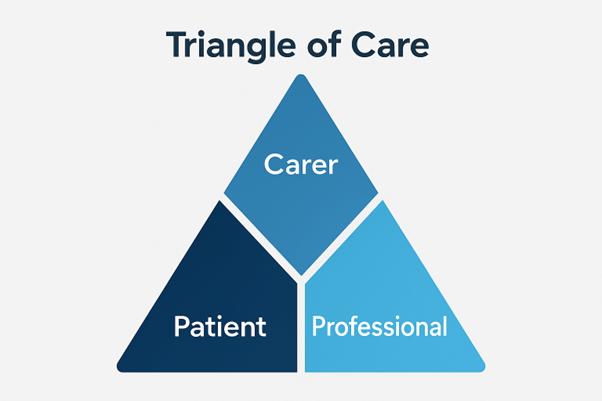
What is the Triangle of Care?
Most carers recognise that there is a three-way partnership between the service user, carer and clinicians. We call this the ‘Triangle of Care’, with all the voices being heard and influencing care treatment decisions to produce the best chance of recovery. The responsibility is on the professionals and services to actively encourage partnership with you as family and carers.
Effective carer engagement will develop by adopting positive practice. This relationship can be reinforced by putting in place key components which invite carer participation, giving information, support and advice in a considered manner. This approach should involve carers in all stages of the process including assessment, care planning, and eventual discharge.
What is the Secure Mental Health Toolkit?
The Secure Services Toolkit has been developed by NHS England in partnership with the University of Central Lancashire. It has been co-produced by a group involving a wide range of experience and expertise, most importantly carers themselves.
What it aims to do?
The toolkit is intended to:
- Improve carer involvement in secure mental health care
- Provide clear information about how secure services work
- Support carers emotionally and practically, recognising the unique challenges in forensic settings
- Share best practice based on research and lived experience
The toolkit includes:
- Practical guidance for navigating secure services
- Information about carer rights and involvement
- Links to short films created by people with lived experience
- Advice on communication, confidentiality, and support
Link to the toolkit
Access the toolkit:
Confidentiality and information sharing
Patients have the right to choose how much information is shared with you as a significant person in their life. For example, they might decide you can be involved in their Care Programme Approach review meetings. Confidentiality can be a difficult area. Sometimes a patient will share information with you then suddenly they stop doing so. When this happens, it may be because they are unwell.
If you want to telephone to see how your relative is you will need to call the ward; however, there may be information we cannot share with you. We can only share information that your family or friend has consented to; we are allowed to receive information from you regarding the patient and this will be recorded as Third Party information. You can tell us if you do not want certain things sharing with your relative.
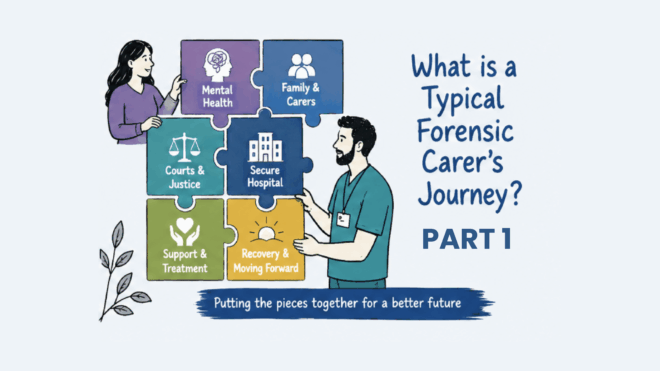
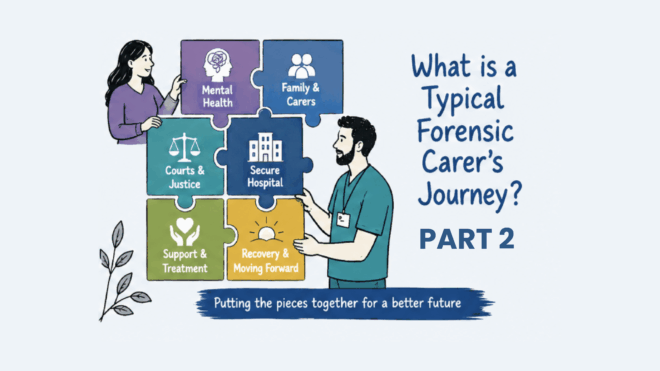
What is a typical forensic carer’s journey?
A typical forensic carer has been on a very eventful journey before their cared for even reaches secure services. Most will have been through the process of their cared for becoming so unwell a crime has been committed and the police and/or courts have been involved. Often our experience of mental health services has been less than ideal. Often people will say that if only we had received the right support, earlier in the journey, then the offending may not have happened.
It’s a very bewildering experience to encounter secure services / forensic services. Your loved one/ friend will be coming into hospital under a section of the Mental Health Act. There will be other people on the ward on a variety of mental health act sections. Some of our patients / service users are transferred prisoners, some are awaiting trial and other people come from general mental health wards who need specialist support.
The hospital is a therapeutic environment to help treat people’s illness and help them move on.
What are your rights as a carer?
The Care Act 2014 outlines new rules about individuals who are carers.
You now have a right to an assessment of need and a support plan for yourself and the threshold for being viewed as a carer has lowered to ‘Having needs for support, whether this is now or in the future’. We can support you in getting the correct carers assessment in your local area. Please ask the ward’s social worker about how to receive an assessment of your support needs as this will need to be completed in the area where you reside.
Taking Care of yourself as a carer
Below is a quote from one of our carers:
“Once your friend or family member is settled on their ward, you may start to experience delayed reactions to what has gone on up to this point and now look to your own needs. This could be counselling, or other psychological therapies. Time out doing hobbies and pursuing other interests, finding times to visit friends or even a shopping trip, that you haven’t been able to manage for some time. You need to recover too. “
It may be that you need to visit your G.P for a referral to the most appropriate support. Below are a list of helpful contacts and sources of information:
What is the Carer Lead role?
The Carer Lead is a dedicated role within the Forensic Directorate which has been developed to champion the carer voice within our services, ensuring the service complies with national standards. The Carer Lead is responsible for leading on the delivery of the Carer Strategy which includes embedding carer involvement and lived experience into clinical practice and service improvements.
The Carer Lead can be contacted via email: ForensicCarersLead@mpft.nhs.uk or 01743 210079 (this number is not monitored 24/7 but there is a facility to leave a message).
What is Care Opinion? Share Your Experience.
Your feedback is important to us.
We are committed to continually improving our Forensic Service and the support we provide to carers and families. If you would like to share your experience, we encourage you to leave feedback through Care Opinion.
Care Opinion is an independent platform where you can share your views about the care and support you or your loved one received. Your feedback helps us understand what we are doing well and where we can improve.
Your story will be handled confidentially by the non-profit service Care Opinion. Your story may appear (without your name) on their website. Care Opinion asks the health service to respond to the feedback you share, but does not reveal your identity.
This service is independent of MPFT and the NHS. For more information about Care Opinion and how your story is handled, visit www.careopinion.org.uk.
Useful Contacts
Here are some useful contacts that you may need whilst your friend or relative is in hospital:
North Staffs Carers Association – 01782 793100
Asist Advocacy for Stoke and Staffordshire – 01782 845584
Stafford and Cannock League of Hospital Friends – 01785 221372
First Point of Contact, Shropshire – 03456 789044.
Crossroads Together – 01743 341995 or 0333 323 1990
The Carers Centre, Telford – 01952 240209
Useful Links

MIND
A leading mental health charity providing trusted information, support, advice and advocacy to ensure no one has to face a mental health problem alone.

Rethink Mental Illness
Helping people affected by mental illness live well, access support and realise they are not alone.

NHS England Secure Carers Toolkit
Supporting carers to be recognised, involved and valued as partners in care within secure mental health services.

Shropshire Carers Support
Supporting unpaid carers with information, advice and guidance to help them balance caring and their own wellbeing.

Telford Carers
Providing free information, advice, emotional support and practical guidance to unpaid carers of all ages, helping them navigate their caring role and maintain their own wellbeing.